The Replica Rolex Milgauss Cult Classic That Refused to Conform

In the vast and meticulously ordered universe of Rolex, the Milgauss has always existed slightly out of phase. It does not dive deeper than its peers, travel across time zones, or climb mountains. Instead, it resists something far less romantic but infinitely more modern: magnetism. And in doing so, it has become one of the most unconventional – and quietly fascinating – watches the Crown has ever produced.
From its lightning-bolt seconds hand to its experimental use of color and crystal, the Milgauss was never designed to disappear into a boardroom or blend seamlessly into a collection. It was built with intent, identity, and a degree of stubborn individuality that sets it apart from Rolex’s more commercially dominant icons.

The story begins in the 1950s, an era defined by rapid advances in science and engineering. Laboratories were filling with particle accelerators, electrical generators, and magnetic fields strong enough to wreak havoc on mechanical timekeeping. Scientists and engineers discovered that their watches – precision instruments in their own right – were losing accuracy as magnetism interfered with balance springs and escapements. Rolex responded not with theory, but with a tool.
The original Milgauss, Reference 6541, was developed specifically for professionals working in extreme electromagnetic environments, including researchers at CERN. Its defining innovation was an inner soft-iron case that formed a Faraday cage, shielding the movement from magnetic forces up to 1,000 gauss – hence the name Milgauss. It was an unapologetically technical solution, wrapped in a design that was equally bold. The jagged lightning-bolt seconds hand, now synonymous with the model, made its debut here as both a visual metaphor and a declaration of purpose.
Early Milgauss references were produced in limited numbers and evolved quietly. By the time Reference 1019 arrived, the watch had taken on a more restrained appearance, shedding the lightning bolt in favor of a straight seconds hand and a cleaner dial. Despite its technical merit, the replica Rolex Milgauss never achieved mass appeal. In 1988, it disappeared from the Rolex catalog entirely, eclipsed by sportier, more marketable siblings.
Its return in 2007 was unexpected – and unmistakable. The modern Milgauss, Reference 116400, reintroduced the lightning-bolt hand and embraced color with confidence. Orange accents punctuated the dial, polished surfaces replaced tool-watch austerity, and the watch was offered in multiple personalities. Most notably, the 116400GV introduced Rolex’s green sapphire crystal – a proprietary, in-house creation that remains unique within the brand’s catalog.
At the heart of the modern Milgauss beats the Caliber 3131, a movement engineered specifically for magnetic resistance. Based on Rolex’s proven architecture, it integrates paramagnetic components and a blue Parachrom hairspring, crafted from a niobium-zirconium alloy. The result is a movement largely unaffected by magnetism, highly shock-resistant, and chronometer-precise, without sacrificing durability or longevity. This is Rolex engineering at its most pragmatic – innovation that serves a purpose rather than chasing spectacle.
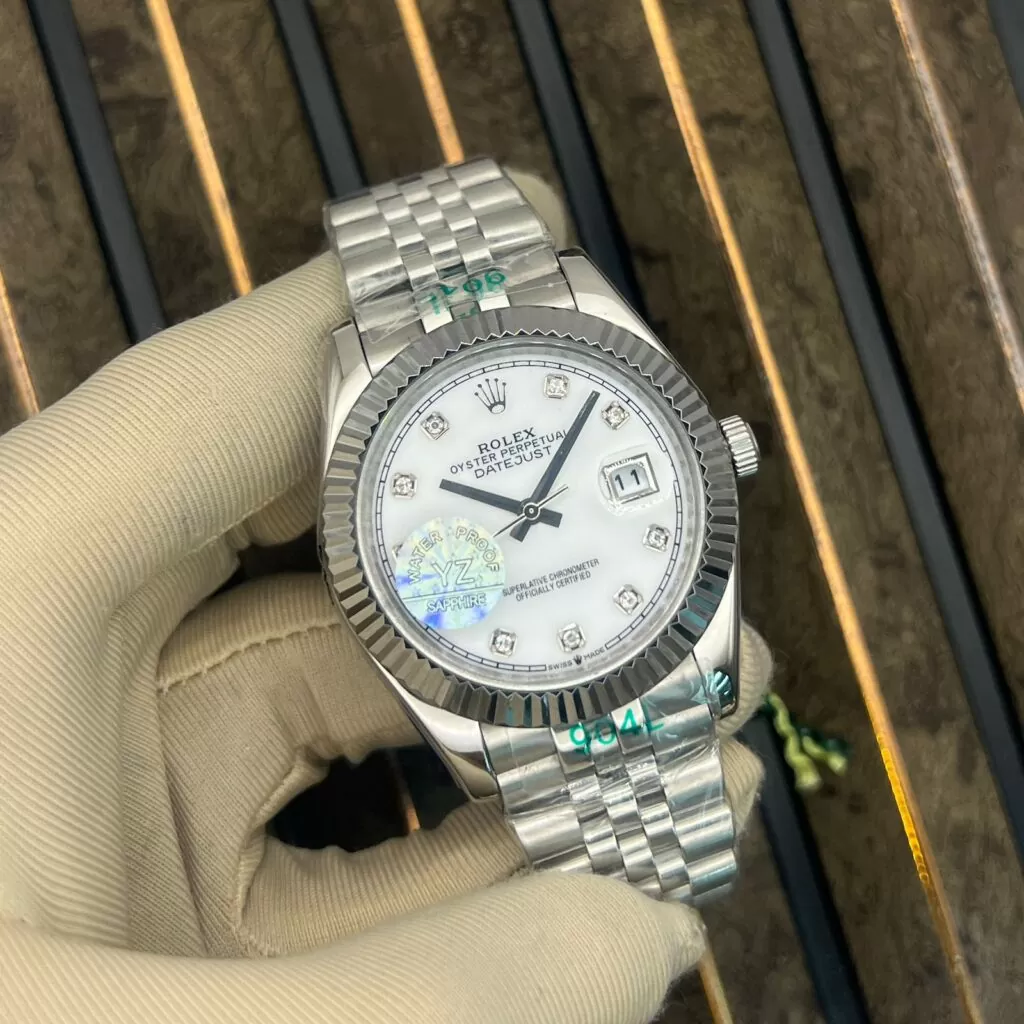
No discussion of the Rolex Milgauss is complete without addressing its most polarizing expression: the Z-Blue dial. Paired exclusively with the green sapphire crystal, this metallic electric blue surface reacts dramatically to light, shifting from cool depth to near-neon intensity. For some collectors, it represents Rolex at its most playful and daring; for others, it crosses into excess. That division is precisely what has elevated the Z-Blue Rolex Milgauss to cult status. In a brand defined by cautious evolution, this was Rolex taking a rare aesthetic risk.
More restrained options – the black and white dials – offer greater versatility, allowing the orange accents and lightning hand to shine without overwhelming the design. Yet even in its most conservative form, the Milgauss never pretends to be invisible. Its polished bezel and center links lend it a dressier presence than most Rolex tool watches, blurring the line between professional instrument and expressive luxury.
On the wrist, the Milgauss wears differently from its 40mm contemporaries. The internal Faraday cage adds thickness, giving the watch a taller profile than an Explorer or Datejust. Some will appreciate the added presence and weight; others may find it less accommodating under a cuff. Comfort, however, is assured by the Oyster bracelet and Rolex’s Easylink extension system, allowing subtle, tool-free adjustment throughout the day.
In 2023, Rolex quietly discontinued the fake Rolex Milgauss once again, sealing its fate as a completed chapter rather than an evolving one. Predictably, collector interest surged – particularly for the Z-Blue 116400GV, now widely regarded as the most distinctive and unlikely to be revisited. Vintage references inhabit a different stratum altogether, appealing to purists drawn to historical significance over modern wearability.
What ultimately defines the Milgauss is not its specifications, nor even its scarcity, but its refusal to conform. It was born as protective equipment, reborn as a design statement, and matured into a collector’s replica watch that values character as much as pedigree. In a sea of instantly recognizable Rolex silhouettes, the Milgauss remains unmistakable precisely because it does not look like anything else the Crown has ever made.
For collectors who want a Rolex that challenges expectations rather than reinforcing them, the Milgauss stands alone – charged with history, alive with personality, and forever a little bit electric.